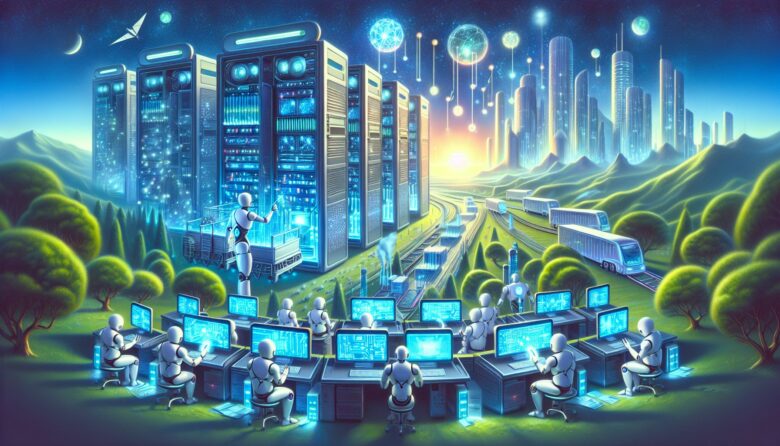
Welcome back to another deep dive into the world of emerging technologies and the fantastic wonders they hold for the future. Today, we’re dialing into a topic that hits me right in the feels and stretches the imagination to whole new vistas: Artificial Intelligence (AI). Specifically, how AI is ushering us into what I’m calling the Age of Sovereign Computation, where AI takes on a massive role in our existence. We’re venturing beyond simple automation into a realm where AI partners with us, reshapes industries, and stretches the boundaries of what’s possible.
Introduction to the Age of Sovereign Computation
So, what exactly is Sovereign Computation? Picture a world where AI technology is robust and autonomous, no longer a mere tool but a formidable ally capable of independent decision-making and creative problem-solving. This transformation from a set of reactive algorithms into proactive, self-sustaining entities might redefine how we think about creativity, decision-making, and even intelligence itself. It’s like your “AI buddy” has leveled up from a sidekick to a co-protagonist in our shared digital story.
How did we arrive here? Well, over the past decade, AI has primarily focused on pattern recognition, crunching data, and churning out results with machine-like precision. But now, with advancements like OpenAI’s GPT-4, Google’s DeepMind, and distributed neural networks, we’re beginning to see AI systems that can generate original ideas, make sense of abstract concepts, and even come up with technologically feasible solutions.
AI Technologies Changing the Game
Let’s dig into some of the AI technologies that are placing us on the brink of sovereignty in computation.
1. Generative AI: Creativity Unleashed
There’s a seismic shift happening with AI’s creative capabilities. Gone are days when creativity was thought solely as a human domain. Generative AI models are churning out impressive artwork, composing original music, and even crafting stories that echo deep human experiences. With tools like DALL-E turning text-to-image synthesis into a spectacular show and advancements in platforms like DeepArt, generative AI is an artisanal revolution.
For creative professionals, the key is adaptability rather than resistance. Imagine combining AI-generated drafts with human insight, developing unique artistic expressions that challenge traditional aesthetics while reducing the cognitive load on creators. Used wisely, this isn’t just AI taking jobs. It’s AI reshaping the very world of what’s creatively possible.
2. Machine Learning: Decision-Making Mavericks
We all know machine learning algorithms as data-crunching wizards, right? But now, thanks to evolved architectures like transformers and new frameworks, machine learning tools are moving past just ‘predictive analytics.’ They’re integrating with real-time systems, empowering businesses to pivot strategies based on a dynamic range of parameters and predictions.
For instance, AI-driven supply chain management can foresee bottlenecks and recalibrate operations smoothly, learning and adapting with every decision. This agility will transition AI from being a supportive tool to being a full-fledged operational co-pilot capable of driving competitive strategies and real-time innovation.
Autonomous AI Systems: Independence Through Technology
The rise of autonomous AI systems is a radical departure from traditional AI models. This new breed of AI doesn’t just operate on learned datasets but thrives in environments it hasn’t been pre-defined to handle. Take autonomous vehicles, for instance, where AI simultaneously processes real-time traffic data, navigational math, and predictive analytics to navigate roads, all while continuously learning.
Likewise, autonomous drones are becoming the backbone of smart agriculture, conducting aerial surveys and automating seeding and fertilization based on crop data. These amazing advancements show a vision of AI that’s less about repeating the past and more about generating solutions on the fly, an embodiment of sovereign computation.
Challenges of Sovereignty: The Flip Side of AI Advancements
Of course, with great power comes great responsibility, and transitioning into a world of sovereign AI presents its own set of challenges.
1. Security and Ethics in the Age of AI
With AI systems taking on autonomous roles, ethical considerations and security challenges are thrust into the limelight. Can we trust AI to make decisions in realms as delicate as surveillance or medical treatment without an embedded code of ethics? More critically, as AI systems gain autonomy, they increasingly become targets for cyber threats.
AI security has to evolve, moving from standard cybersecurity protocols to an AI-driven security strategy that prioritizes predictive threat detection and AI-self repair mechanisms. Furthermore, the dialogue around AI ethics needs to reflect these advancements, ensuring AI autonomy doesn’t come at the expense of human oversight.
2. Bias and Fairness: Uneven Playing Fields
Unfortunately, AI systems are prone to inherent biases based on their training data. As sovereign computation takes the reins, addressing these biases becomes even more important.
Think about an AI making HR decisions, for instance, or determining creditworthiness. If left unchecked, its biases could make inequality worse. Developers need to focus on fairness and transparency, ensuring that AI treats all users equitably and respects diversity.
Conclusion: Embracing Sovereignty
So, there you have it, a brief glimpse into the compelling potential of sovereign computation and the AI that makes it all possible. While challenges abound, I maintain a techno-utopian view that these hurdles will be mere speed bumps on our path to a future redefined by collaborative intellection and autonomous innovation.
What excites me the most isn’t just what AI can do for us but what artists, creators, and developers can do with AI. This isn’t a displacement of humanity but a redefinition of our roles within a more intelligently assisted framework. When we pair human ingenuity with sovereign computation, the road ahead becomes not just a journey but an adventure.
Guard your optimism, lean into future-forward thinking, and let’s keep exploring the infinite cosmos of emergent technology. There’s no limit to what we can achieve when humanity and AI walk hand-in-hand into tomorrow.
Until next time, keep your coding spirit strong and your curiosity even stronger. Let’s continue this conversation in the comments. Are you on board with autonomous AI, or does it leave you dreaming of Luddite utopias? Let’s talk about it. Cheers!