
The Operating Theater Never Closes
I spent most of the 2000s managing infrastructure at a financial services company. We ran systems that processed transactions worth billions daily. The network never shut down. The databases never went dark. When you’re responsible for that kind of operation, you develop a particular kind of respect for boring things: redundancy, documentation, institutional knowledge, and the people who understand where all the bodies are buried in your codebase.

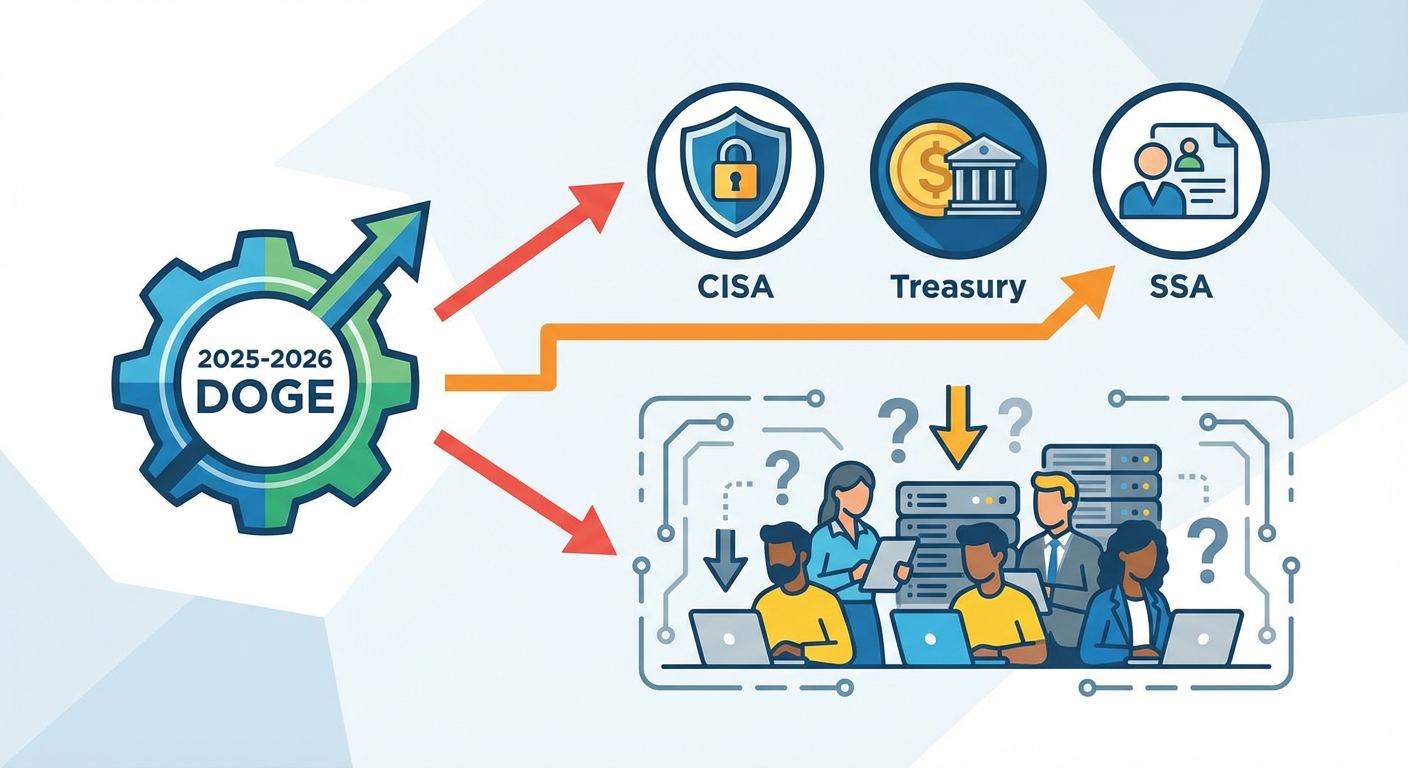
What I watched happen across federal agencies in early 2025 felt like watching someone perform surgery on a patient while the patient is still conscious and working. You don’t cut blindly when systems are running. You don’t dismiss the people who know where the critical load-bearing walls are. Yet that’s exactly what happened when the Department of Government Efficiency pursued staffing reductions across the Social Security Administration, Treasury, and the Cybersecurity and Infrastructure Security Agency.
The problem isn’t that government IT needed scrutiny. It did. It does. But there’s a difference between optimization and amputation. One requires understanding the organism. The other just requires a saw.
When Your Security Team Becomes a Skeleton Crew
CISA lost approximately 130 employees through early 2025 reductions. On paper, that’s a line item. In practice, it means specific people who understood specific vulnerabilities, who maintained relationships with specific vendor teams, who knew how to coordinate between agencies when a critical flaw surfaced, were simply gone.
The National Vulnerability Database, maintained by NIST, shows what happens when you remove institutional knowledge from critical infrastructure. The enrichment backlog started accumulating in early 2024 and continued deteriorating through 2025. Thousands of CVEs sat in the queue waiting for analysis. When security researchers couldn’t get clear information about what was actually vulnerable and what wasn’t, the entire defense apparatus moves slower. Patches get delayed. Prioritization becomes guesswork. You can check the current status yourself at the NIST NVD backlog status tracker.
Former CISA Director Jen Easterly didn’t mince words in early 2025 testimony. She called reducing federal cybersecurity staffing during a period of heightened nation-state activity a “strategic own goal.” She wasn’t being hyperbolic. Volt Typhoon and other advanced persistent threat actors had spent years embedding themselves in U.S. critical infrastructure. The moment to be thinning your defense team is not when the adversary is already inside your network.
This is the kind of decision that looks good on a spreadsheet for six months. Then the incident happens and you understand what you actually cut.
The Treasury Incident That Should Have Been Preventable
In February 2025, personnel affiliated with the efficiency initiative gained access to Treasury’s Bureau of the Fiscal Service payment systems. These systems process over $5.45 trillion annually. Five trillion, four hundred fifty billion dollars. These systems are not experimental. They’re not development boxes. They’re the literal financial transmission equipment of the United States government.
This incident triggered congressional oversight hearings. It should have. What happened there illustrates a core truth about legacy infrastructure that people without deep systems experience often miss: access controls exist for reasons that predate your organizational chart. The people who built those systems knew something about why certain separation of duties matters. They’d usually learned it the hard way.
When you start granting access to systems because it seems like the thing to do in a staffing reduction, you’re not being efficient. You’re skipping steps that other people bled to build. You’re treating institutional memory as optional.
The CISA workforce reduction coverage – CyberScoop captures some of this dynamic. The people responsible for understanding the gaps were often the first ones removed.
What This Means for Your Career
If you’re working in federal IT or cybersecurity right now, you’re operating in a genuinely difficult environment. The people who left or were forced out created knowledge gaps that remaining staff have to somehow manage. The documentation was probably never as complete as it needed to be before. Now it’s definitely incomplete.
Here’s what I’d tell someone in that position: document everything you touch. Make it clear. Make it transferable. Not because you’re planning to leave, but because the organization clearly can’t rely on institutional knowledge staying put. Write runbooks. Record your processes. Make the implicit explicit. If you understand something about the system that nobody else does, write it down today. Not next week.
For anyone considering a career in government IT, understand what you’re signing up for. The compensation is modest. The infrastructure is old. The political winds are unpredictable. But if you’re the type of person who finds meaning in reliability and in serving systems that actually matter, it’s worthwhile. Just keep your resume current and your skills portable.
The Actual Cost of Cuts
The people making these decisions likely understand cost accounting perfectly well. They can read a spreadsheet. What they often don’t understand is that infrastructure has an entirely different cost structure than, say, administrative overhead. You can cut travel budgets. You can reduce meeting room catering. Those things are genuinely optional. But when you cut the people who understand how your systems work, you’re not saving money. You’re deferring costs.
Those deferred costs show up as incidents. As slower response times. As missed vulnerabilities. As systems running more fragile than they need to. Everyone in this industry has seen it happen in the private sector. Some company gets bought, the new owners cut infrastructure teams to boost quarterly numbers, and three years later there’s a major failure that costs ten times what they saved.
Federal systems are more complex and more critical than almost anything in the private sector. The math doesn’t change, but the consequences do. When Social Security goes down, sixty million people can’t access their benefits. When Treasury systems fail, the financial system stutters.
I’m not here to tell you what policy should be. I’m here to tell you what I’ve seen happen when organizations treat systems people as optional. It’s not complicated. It’s just costly.
What’s your experience been? If you’re in federal IT or have dealt with infrastructure cuts at your organization, I’d genuinely like to hear what you’ve observed. Send me a note. These conversations matter more than most people realize.