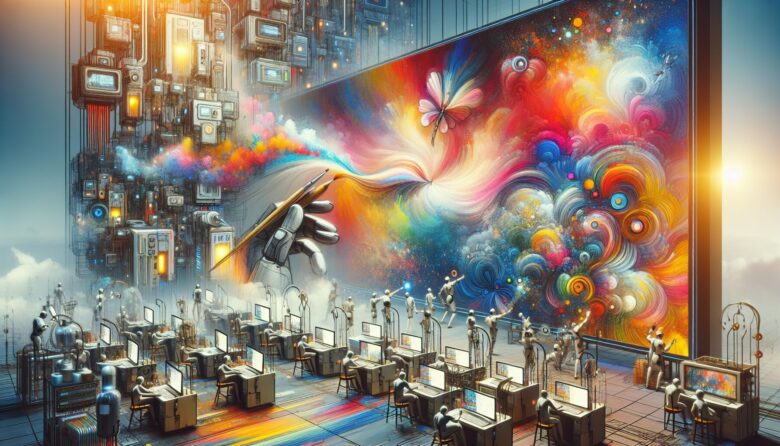
Hey tech aficionados! Today we’re diving into one of my absolute favorite areas where cutting-edge technology meets good old-fashioned human creativity. We’re talking about Artificial Intelligence in the creative arts, where human imagination meets machine learning to churn out incredible masterpieces. Trust me, it’s as cool as it sounds.
The Digital Renaissance: Beyond Classical Artistry
So picture this: we’re in a ‘Digital Renaissance’ era where neural networks can paint like Van Gogh, compose symphonies like Beethoven, and write prose as gripping as anything Orwell or Hemingway ever produced. Doesn’t that blow your mind? Gone are the days when AI was just about solving a deterministic set of problems. Today, it’s mimicking human creativity, and even better, enhancing it!
Take DALL-E by OpenAI, for example. You give it a simple text description, like “a two-headed flamingo doing gymnastics in Paris,” and this digital Picasso will whip up a visual that’d probably make an Impressionist painter tip their hat. AI is becoming the new brush, the new pen, and even the new muse. It’s changing what it means to be creative.
Artists, Meet Your New Collaborators: AI
Now, let’s talk about collaboration. If you think AI is just taking over jobs and will someday replace human artists, here’s a perspective shift: AI is more like a collaborator, or even an artistic tool. As a designer or musician, using AI is like wielding a futuristic paintbrush or an instrument that lets you explore endless creative dimensions. Think of it as Photoshop on steroids, allowing you to do way more than retouching photos. It can help you come up with zillions of creative iterations, leaving you with the best options to express your vision.
Then there’s the tale of the Ai-Da Robot, the world’s first ultra-realistic AI humanoid robot artist. This marvel has already held a solo exhibition, showing off her (its?) unique style that merges machine precision with human abstraction. While some critics argue about the authenticity of AI-generated art, there’s no denying it has carved out a name in the art world.
Disrupting the Music Industry: AI on the Beat
And the magic doesn’t stop at visual arts. Music is another field getting a full-blown AI upgrade. Algorithms can now compose music that strikes chords deep in the human soul. Ever heard of Jukedeck? This clever AI creates custom music tracks in minutes, perfect for your next indie film project or YouTube video. Sure, it might not dethrone Mozart just yet, but it’s a game-changer for independent creators.
AI music generators are pushing boundaries and changing ownership and authorship in music. Imagine your favorite bands collaborating in virtual space with AI, generating tracks where you’d find groovy symphonies that none of the band members alone could conceive. It’s like a jam session where the smartest attendee is your laptop.
Let’s Discuss the Downside: Challenges on the Horizon
Now with every rosy scenario comes a couple of prickly thorns. The discussion around ethics and authenticity is like the room’s background music in any AI conversation. Who owns a piece of AI art, the programmer or the machine? And what happens if an AI-written screenplay makes it to the Oscars’ Best Screenplay category? These are questions we’re only starting to sort out.
There’s also the potential risk of homogenization, where AI might push toward a ‘popular’ formula, stifling artistic diversity. I mean, creativity without deviation is a little like painting by numbers, don’t you think? Regulatory bodies, creators, and technologists need to come together and set the rules of this new digital playground.
The Future of AI in Arts: Speculating Beyond the Canvas
Peering into the crystal ball, it’s exciting to consider where this is all headed. One potential future may include hyper-customized experiences. Imagine walking into a gallery and having AI curate an exhibition based entirely on your personal taste. Talk about Netflix, but for art!
On the other end, schools and educational platforms might use AI to teach aspiring artists to marry traditional art with technology, preparing future Picassos and Rembrandts for a digital-first world.
Who knows? Maybe in ten years, virtual reality galleries could be a thing, where you’d experience tactile sensation combined with visual and auditory stimuli, all powered by AI. It’s an exhilarating time to be alive, especially if you love where tech meets art.
Wrapping It All Up
Well folks, it’s all electrifying, this heady blend of circuits and creativity. While there are definitely some teething issues to address, AI in the creative arts is a brave new world we should all be excited about. It’s like we’ve gotten new colors on our palette, neural-network gray, if you will.
Here’s to all the techies out there who can wield a paintbrush or hum a tune. This is our moment to shine at the intersection of pixels and pigment. I, for one, can’t wait to see what masterpieces come next from humans, sometimes with a little help from our digital companions. Keep hacking away and creating, folks. The best is yet to come!