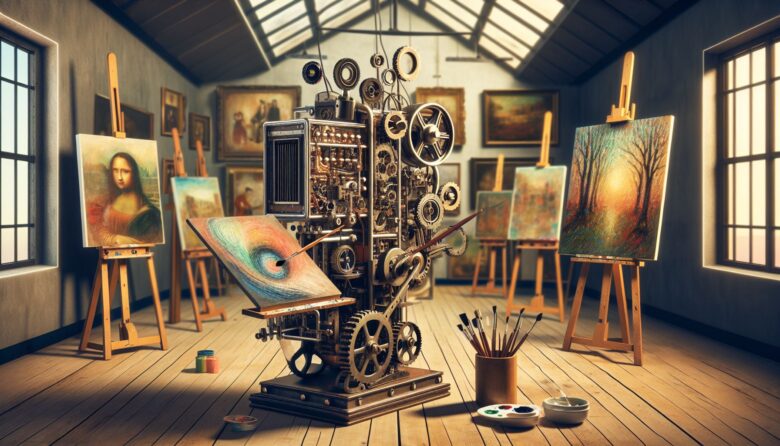
Step right up, ladies and gentlemen, to witness the spectacle that is Artificial Intelligence taking a brush to the canvas of creativity! Today, we’re diving into how AI isn’t just a sideline act in the tech circus but is stepping into the spotlight, revolutionizing the creative arts like never before. So, grab a cup of your favorite brew, get comfy, and let’s explore this pixelated Kandinsky together.
Why the Fuss Over AI Creativity?
Let’s kick things off with a bit of context. Why are we even talking about AI in the arts? Simple. Creativity has always been seen as a distinctly human trait, our last bastion in the ever-growing domain of machines. It’s the arena where Picasso, Van Gogh, and Beethoven reign supreme. But hold on to your berets, because AI is crashing this creative party, making us wonder if machines can be true artists.
Think of AI as that awkward yet undeniably talented intern at the studio who started dabbling with paint and BAM! Suddenly they’re displaying their work alongside the masters. In this way, AI isn’t just mimicking. It’s innovating.
The Tech Behind the Masterpieces: Generative Adversarial Networks
To pull back the curtain a bit, let’s look at the magic trick up AI’s sleeve: Generative Adversarial Networks, or GANs for those who love acronyms. These clever algorithms are like the dynamic duos of the AI world. Picture Batman and Robin but for image generation. One network, the generator, creates, while the other, the discriminator, acts as the harshest art critic this side of the digital divide, assessing the creations for authenticity.
The back-and-forth game of creation and criticism produces human-like pieces of art. These artworks have managed to even baffle seasoned art critics, making them wonder if AI might be the next Warhol or Banksy.
From Brushes to Bytes: AI in Visual Art
Visual art is where AI has really shown off. Remember “Edmond de Belamy”? The portrait generated by an AI and sold for a staggering $432,500 at a Christie’s auction? That’s right, a computer-generated artwork that commanded more dollars than most of us are likely to make off our homemade Etsy creations. It’s not just about generating visuals. Artists are using AI as a kind of muse, kicking their own creative juices into overdrive.
The potential is wild. AI can analyze entire art movements, remix styles, and even propose entirely new forms of art. Algorithms trained on centuries of human creative output now propose pieces that stick out as avant-garde, sometimes eerily so. Like the surreal? AI’s got you covered.
AI Hits the Airwaves: Music and the Machines
Oh, music! The sound of emotion through time. AI has waltzed into this sphere, too, with OpenAI’s Jukebox leading the charge. Lurking in its digital depths are countless hours of genre-spanning music. Imagine a jam session where Beethoven and the Beatles are riffing together, courtesy of AI.
Spotify even uses machine learning to craft hyper-personal playlists, ensuring that your daily soundtrack is as unique as a snowflake. The next hit chart-topper might very well have an AI collaboration in its credits.
Spilling Ink: Words at the Hands of Robots
How about turning the literary world on its head? AI is channeling its inner Shakespeare, cranking out poems, scripts, and full-length novels. When GPT-3 dropped, it became the Goethe of the algorithmic age, flexing its knack for compelling prose.
Granted, not everything AI writes is gold, but the fact that it can compose with any semblance of coherence is impressive. We’re stepping into a future where publishing houses might list AI as co-authors (or maybe even lead authors!). Who needs writer’s block when your AI partner is ready to take the next chapter?
Where Do We Go From Here? Bumps and Breakthroughs Ahead
But all is not roses and rainbows in AI’s world. With big leaps come big questions. Does AI-generated art hold the same emotional depth? Who owns an artwork created by an AI? What happens when humans are no longer at the genesis of creativity?
Critics argue there’s a soul, a uniqueness of humanity, that AI just can’t replicate. These discussions aren’t just academic. They’re philosophical earthquakes that will shape our cultural norms and copyright laws.
Then there’s the tech road ahead. As AI systems become more advanced, they’ll need not just more data but more nuanced understanding of context and emotion. And while AI can generate incredible results, it’s humans who curate, select, and often finalize the artwork that shines.
The Human Touch Remains Irreplaceable
I think the sweet spot of AI in creative arts lies in partnership. Like a dynamic duo or a classic combo, AI and human creators complement each other, each bringing their own strengths to the table. It’s not about replacement but enhancement. The artists who embrace AI today could well be the pioneers of a new creative renaissance.
So there you have it. The canvas of creativity isn’t limited by the reach of human hands anymore. It’s being painted by the collaborative strokes of humans and machines alike. The creative world is changing, and it’s happening one pixel at a time.